Endless Ocean Waves

Naveen Kumar
| 02-03-2026
 · Information Team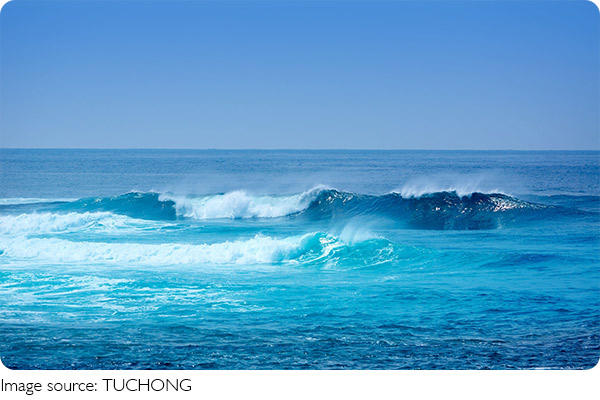
Have we ever stood by the sea and simply watched the waves for a few minutes? At first, it may seem like a simple rise and fall of water.
But if we slow down and really observe, we begin to notice rhythm, pattern, and power. Waves are not random movements. They are the visible result of energy traveling through water. When we understand waves, we begin to see the ocean differently. What looks soft and playful can also carry strong force. What feels calm can hide deep motion underneath.
What Exactly Is a Wave?
A wave is energy moving through water. It is important for us to remember this: the water itself does not travel across the ocean from one shore to another in the way we might imagine. Instead, the energy moves forward while the water particles mainly move in circular paths.
Debt Can Supercharge Returns… Until This Metric Breaks
Gold’s “Safety Switch” Activates in Volatility—Here’s How to Use It Without Overdoing It
What if we could pull carbon straight out of the sky to save the planet?
This “Empty Air” Above Your Home Could Become Your Next Big Asset
Your House Is Hiding Cash—Here’s the Safest Way to Unlock It Without Regret
Discover the surprising science behind the sea’s stunning color.
If we picture a small leaf floating on the surface, we will notice it rises and falls as a wave passes. It does not travel far forward unless there is a current or strong wind pushing it. This tells us that waves are about motion of energy, not large-scale movement of water.
This simple idea changes how we understand the sea.
How Do Waves Form?
Most waves we see are created by wind. When wind blows across the surface of water, friction transfers energy from the air into the water. At first, tiny ripples appear. If the wind continues and becomes stronger, those ripples grow into larger waves.
Three main factors affect wave size: wind speed, how long the wind blows, and the distance over which the wind travels across open water. The longer and stronger the wind, the more energy is transferred, and the bigger the waves become.
Underwater activity can also create waves. Movement beneath the seabed can suddenly push water upward, forming powerful waves that travel long distances. These are less common in daily life but remind us how connected water is to the forces of nature.
The Shape and Structure of a Wave
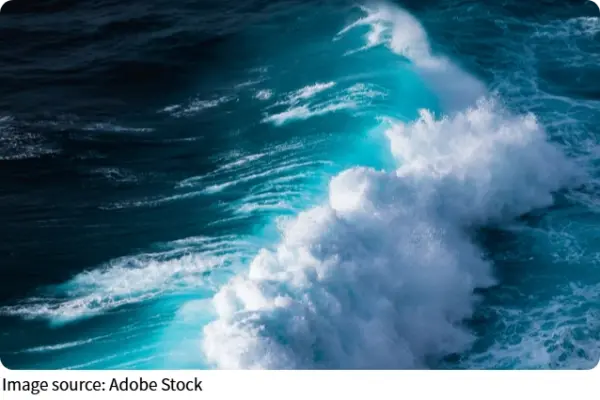
Every wave has parts. The highest point is called the crest. The lowest point between two waves is called the trough. The vertical distance between crest and trough is the wave height. The horizontal distance between two crests is the wavelength.
When we look at waves from the shore, we often focus only on the crest. But beneath the surface, the motion continues. Water particles move in circular paths, with larger circles near the surface and smaller ones deeper down. As depth increases, movement becomes weaker.
This is why deep underwater areas can remain relatively calm even when the surface looks active.
Why Do Waves Break Near the Shore?
As waves travel across deep water, they move smoothly. But when they approach the shore, the situation changes. The bottom of the wave begins to interact with the seabed. Friction slows down the lower part of the wave while the top continues moving faster.
This difference causes the wave to tilt forward. Eventually, the crest collapses and crashes down. That is the breaking wave we see and hear at the beach.
The energy that traveled across long distances is finally released near the shore. We can feel it when water rushes around our feet. That force is the final stage of energy transfer.
The Power Hidden in Waves
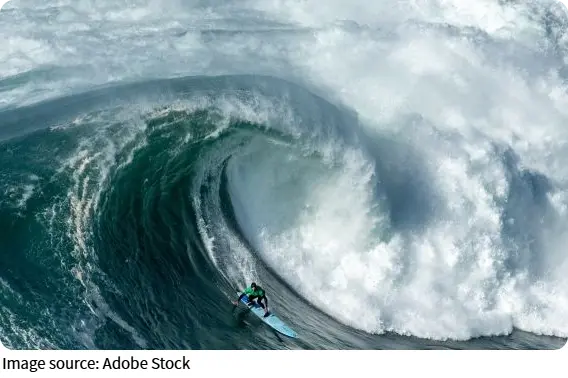
Waves may look beautiful and relaxing, but they carry real strength. Over time, waves shape coastlines, smooth rocks, and move sand along beaches. Even small waves, repeating day after day, can slowly change the landscape.
In some places, wave energy is studied as a source of renewable power. Since waves are driven by wind and natural forces, they offer a steady and predictable form of energy in many coastal areas.
When we watch waves, we are not just seeing moving water. We are witnessing stored and transferred energy interacting with land and air.
Why Do We Feel Calm Watching Waves?
Interestingly, even though waves carry power, many of us feel peaceful when listening to them. The steady rhythm of waves creates a natural pattern. Our minds often relax when exposed to repetitive, predictable sounds.
The rise and fall remind us of breathing. The constant motion without hurry gives us a sense of balance. This may explain why so many people choose the seaside to rest and reflect.
Waves teach us something simple: movement does not always mean chaos. It can also mean rhythm and harmony.
Next Time We Visit the Sea
Lykkers, next time we stand by the ocean, let’s look a little closer. Let’s notice the crest forming in the distance. Let’s observe how each wave grows, travels, and finally breaks. Let’s feel the energy reaching the shore.
When we understand waves, the sea becomes more than scenery. It becomes a living system of motion and balance.
The ocean never truly stands still. And perhaps that is its greatest lesson for us. Even in constant movement, there can be beauty, order, and calm.